

August 7, 2026 •Nelson Quintero
Hospitals across the U.S. have been using an AI tool called Whisper to transcribe doctor-patient conversations. It's remarkably good … until the room goes quiet. Researchers found that during long stretches of silence or poor-quality audio, Whisper sometimes doesn't leave a blank. It invents. Fabricated sentences, imagined dialogue, in one instance even a medication that doesn't exist: "hyperactivated antibiotics." One University of Michigan researcher found invented text in eight out of ten transcriptions he examined.
Think about what's actually happening there. The tool isn't simply mishearing words. Faced with ambiguity and missing information, it continues generating text rather than acknowledging uncertainty.
And it's not just transcription. In 2025, an AI-assisted federal court opinion was withdrawn after attorneys identified fabricated quotations and other factual errors, including quotations attributed to judicial decisions that did not actually contain them. Researchers tracking AI-related legal errors documented dozens of court filings involving fabricated citations in 2025, and by mid-2026 the database had grown to well over a thousand reported incidents.
If you've used AI to draft a presentation, summarize a case, or write an internal memo, you've probably experienced this yourself. Everything reads smoothly until you notice a fact, citation, or detail that you never provided. The surprising part isn't that the AI made something up. It's realizing that the model wasn't malfunctioning, it was simply doing exactly what it was designed to do: filling the vacuum where your information ended.
There's an old idea that explains all of this. Aristotle taught that nature abhors a vacuum — that the universe cannot tolerate emptiness, and if a void starts to form, the surrounding matter rushes in to fill it. As physics, it didn't survive the seventeenth century. But as a description of how generative AI behaves, he may have been over two thousand years early.
At its core, a language model is built to predict the next word, then the next, then the next. It isn't naturally designed to stop at the boundary of what it knows. When the context you provide begins to run out, the model doesn't inherently recognize a missing piece of the record. It generates the continuation that appears most plausible from everything it has seen during training. Recent research from OpenAI suggests this tendency is fundamental to today's models: they are optimized to produce useful answers, not to leave blanks whenever information is incomplete. Silence in an audio recording, a missing case file, an incomplete litigation history, a gap in context — to the model, each is simply missing information waiting to be completed.
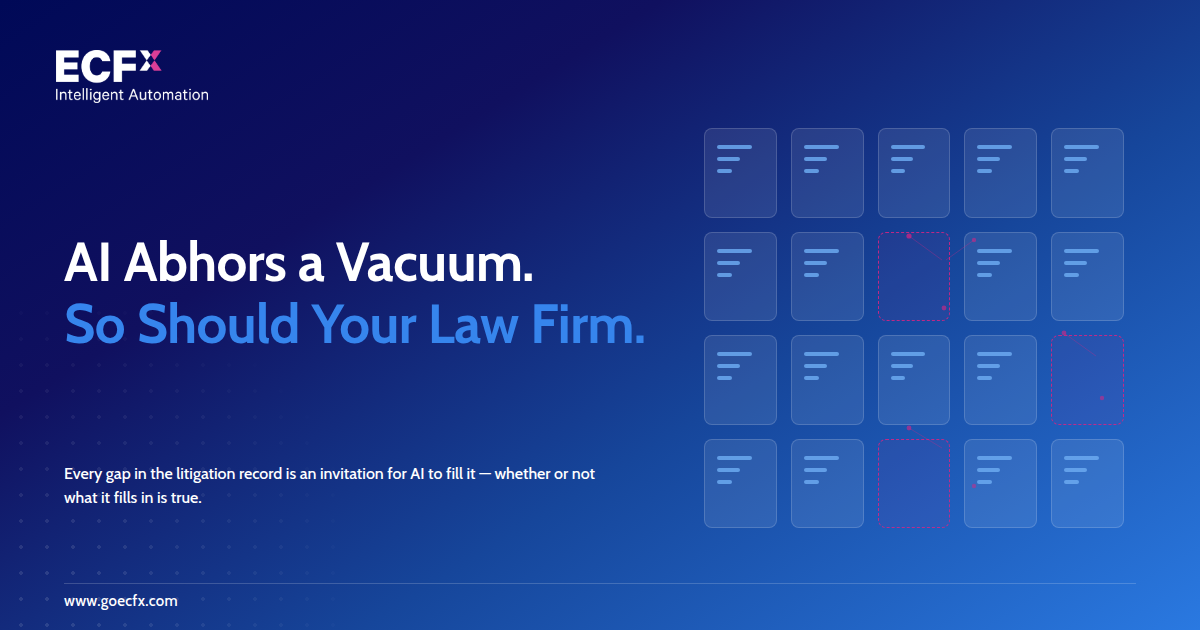
AI abhors a vacuum.
Here's why this matters for law firms, and why it's a bigger issue than double-checking citations.
When you ask AI to analyze a single case, the quality of its answer depends on the completeness of the record you provide. When you ask AI to analyze your entire litigation portfolio — identifying which legal arguments succeed, which judges respond to certain strategies, emerging trends across matters, staffing demands, and potential risks — that requirement compounds. Every active case needs to exist in your case management system. Every filing needs to reach your document management system. Every piece of litigation activity needs to be reflected in the firm's data.
That's the hidden assumption behind every portfolio-level AI question.
At many firms, that assumption fails silently. Court notices arrive in individual attorney inboxes. Cases become active in court but never get opened in the case management system. Filings never reach the document management system. No one knows those gaps exist.
And if neither the lawyer nor the AI knows that part of the litigation record is missing, the model has no reliable way to reason about what isn't there.
It won't necessarily warn you that your portfolio is incomplete. Instead, it will produce a polished, persuasive analysis based on the record it can see. Missing cases become missing exposure. Missing filings become incomplete timelines. Missing documents become incomplete strategy. You won't receive an error message telling you the foundation is incomplete. You'll receive an answer built on an incomplete record—and unless you already know what's missing, it may be impossible to tell where sound analysis ends and hidden assumptions begin.
The lesson isn't that AI is dangerous. It's that AI inherits the quality of the records beneath it. Before firms think about writing better prompts or adopting the latest AI platform, they should ask a simpler question:
Do we actually have a complete litigation record?
You can't prompt your way around missing data. The only solution is to eliminate the vacuum before the AI ever sees it.
That's the problem we built ECFX Notice to solve.
Our platform sits between the courts and the firm's systems, capturing every notice from every supported court and transforming it into a complete, structured litigation record. Every document is automatically downloaded, named, stored, and distributed according to firm-defined rules. And because we reconcile court activity against firm records, we identify the gaps: cases active in court but missing from the CMS, filings that never reached the DMS, litigation activity that would otherwise remain invisible.
The very gaps that could undermine AI become visible—and fixable—before anyone asks the machine a question it cannot answer reliably.
AI is coming to litigation either way, and it will be genuinely transformative for firms that feed it complete, trustworthy data.
For everyone else, remember the part Aristotle got right: a vacuum never stays empty. Something always rushes in.
Whisper wasn't trying to deceive anyone. It simply kept generating when the record became incomplete. Every generative AI system shares that same tendency. The question isn't whether your AI is intelligent enough. It's whether your data gives it enough truth to work with.